
Interviews are a lot like first dates. There’s overindulgence in personal grooming, selecting a great outfit, trying to put your best foot forward and a lot of lying. You have to decide amidst all the prancing around and false promises. The average recruitment funnel rejects 88% of candidates at the interview level. For every nine interviews you attend in your life, statistically speaking, you can get selected in one. Your odds are better than the average slot machine in Las Vegas at roughly 0.02%. With the subjectivity involved and how painful the ordeal of answering ‘Tell me something about yourself can be, I’d much rather take my chances with the slot machine.
There are scores of interview preparedness materials out there. Some quite straightforward. Some rather detailed. Some simple and well laid out. Some may be a bit excessive, while some others are suspiciously questionable. I am not going to write about how to prepare for the material matters of the interview. This article is about the less evident transactions happening in your brain. Our brain is a fickle organ that has to run a complex set of functions to keep the skin suit from falling apart while managing your social media feed and avoiding running into oncoming pedestrian traffic, all while checking out that attractive neighbour person. Interviews create a controlled environment rife with threats and cues that trigger all the wrong places in the brain.
Here are three commonly experienced psychological effects that may be impacting the way you perform in an interview.
Interview Anxiety
Interview anxiety refers to having unpleasant feelings before or during a job interview. It also reflects the fear of partaking in an interview.(1)

Let’s face it. We have all been here. Like the Eminem song, we have had weak knees, sweaty arms but hopefully no vomit on the sweater. Turns out, that stomach-churning sensation we have right before turning up for an interview is interview anxiety. It affects the best of us. Unless you have been drinking buddies with your hiring manager and the god-forsaken HR recruiter in the room, you will usually face a panel of strangers. With the mysterious nature of questions, any candidate is competing against a stacked equation. If the interviewer tries to ask questions and guide the conversation towards trying to trip up the candidate, the stress levels are bound to spike. Not a conducive environment to get to know each other.
Our brain raises alarms in an unknown environment. That’s what enabled our predecessors to survive in the wild. The rush of blood to the limbs and the heightened alertness made them ready to run away from predators. While recruiters, by and large, are predatory creatures swarmed by scavengers in the form of HR teams, they pose less of a threat than a sabre-toothed tiger would. Our reptilian brain perceives the threat and immediately raises the alarms. Remember that interview anxiety will not lead to superior performance. Unless you are planning on running away from the venue, in which case, you are gold!
What to do as a candidate
- Arrive early and get comfortable with the surroundings.
- Remind yourself that this is a conversation / dialogue between adults.
- Count 2 great qualities you have.
- If you are still feeling anxious, declare the same in a humorous way to break the ice.
- e.g. When the interviewer asks to share something that’s not there on the CV, coolly state that you are quite anxious about the whole process. Then smile.
Impostor Syndrome
This one is one of my favourites. Often we find ourselves sitting in places and wondering do we belong here. I am not talking about a black-out hangover and waking up with a traffic cone on your head. I am talking about workgroups, meetings, interviews and interactions where you feel someone will figure out that you are an impostor. As it turns out, almost everyone feels that way. We need to investigate why we experience this to help combat impostor syndrome.
Imposter syndrome is a collection of feelings of inadequacy that persist despite evident success. ‘Imposters’ suffer from chronic self-doubt and a sense of intellectual fraudulence that override any feelings of success or external proof of their competence. (2)
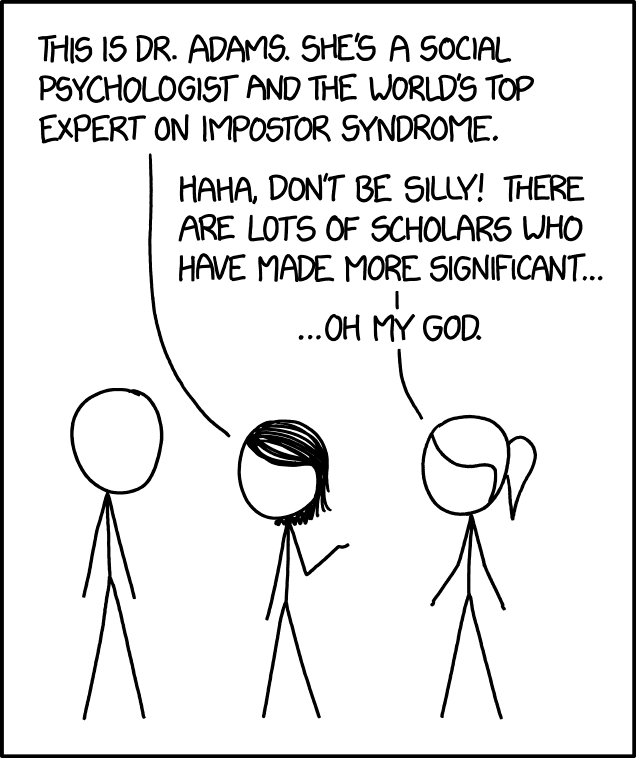
They seem unable to internalize their accomplishments, however successful they are in their field. High achieving, highly successful people often suffer, so imposter syndrome doesn’t equate with low self-esteem or a lack of self-confidence. Some researchers have linked it with perfectionism, especially in women and among academics. – Excerpt from HBR
Most of my students resort to self-deprecating humour and deflection when given a compliment. Scores of my colleagues have been quite sheepish about receiving employee of the month titles or such rewards for superior performance. People find it hard to stake their claim on their success; this usually leaves plenty of bragging spaces for vocal self-promoters like myself.
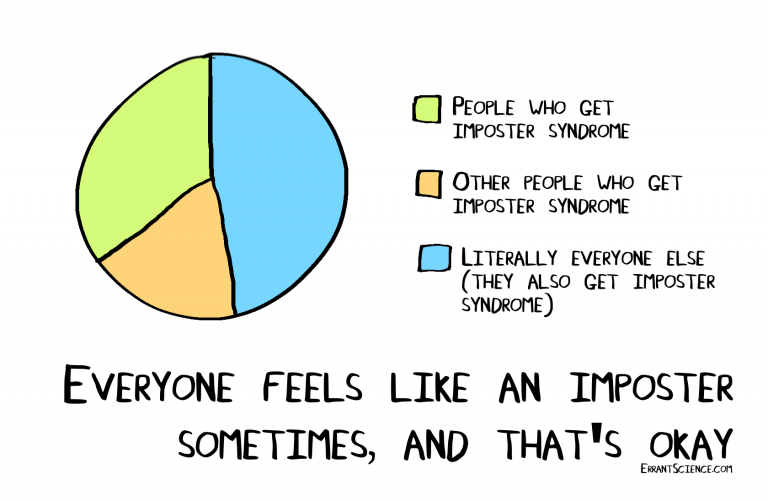
Impostor syndrome has a close correlation with levels of self-awareness. The more self-aware you are, the more you believe that others can see your flaws as well. While underplaying our abilities and achievements, we may also over-emphasise and exaggerate the depth of knowledge and talents others may possess. Below is a Venn diagram of what Impostor syndrome makes us believe and what the reality might be; whereas in reality, impostor syndrome works like this:
Are you a fan of that obscure manga? Do you enjoy watching scam-bait videos? Do you know how to floss (yes, the dance, not the dental hygiene ritual)? There might be things that you have knowledge of and enjoy and things at which you are highly competent. When you interact with subject-matter experts who are also interviewers, it is natural to assume they know more than you do. The interview process itself makes you focus on what you don’t know. Shifting the focus from what you don’t know to what you are good at is a factor in your interview success. You are a collection of experiences, thoughts and perspectives that are valuable to the right team. Let the interviewers know what you are good at and why they should hire you for the role at hand.
How to stop being an impostor at your own party
- Remember that everyone’s body of knowledge holds a teeny-tiny fraction of what they can know.
- Remind yourself that it’s ok to be less than perfect. Everybody is.
- What matters is what you know. What you don’t know is an opportunity and an ineffable open space.
- No individual or collection of individuals can gather, remember, utilise and reproduce the complete set of knowledge required in a specific area of interest / expertise.
- If you are an exception, please get in touch with me. I might have a gig for you.
Spotlight Effect
You said something terrible. You wrote that code incorrectly. You got that answer wrong. You made a mistake. Suddenly all your cognitive resources are dedicated to analysing and brooding over spilt milk. Later at night, you run various scenarios along with a hot shower, processing all the better alternatives. Alas, too little too late. Sounds all too relatable? That’s the spotlight effect at work.
Psychologists define The Spotlight Effect as a person’s tendency to overestimate the extent to which others notice, judge, and remember his or her appearance and behaviour. (3) To put it simply, contrary to our experience, we believe that people care a lot about what we say or do. Hence the fixation on the errors in our ways. Try recalling the last mistake or embarrassing moment that involves a colleague or a friend committed. As I said, nobody cares.
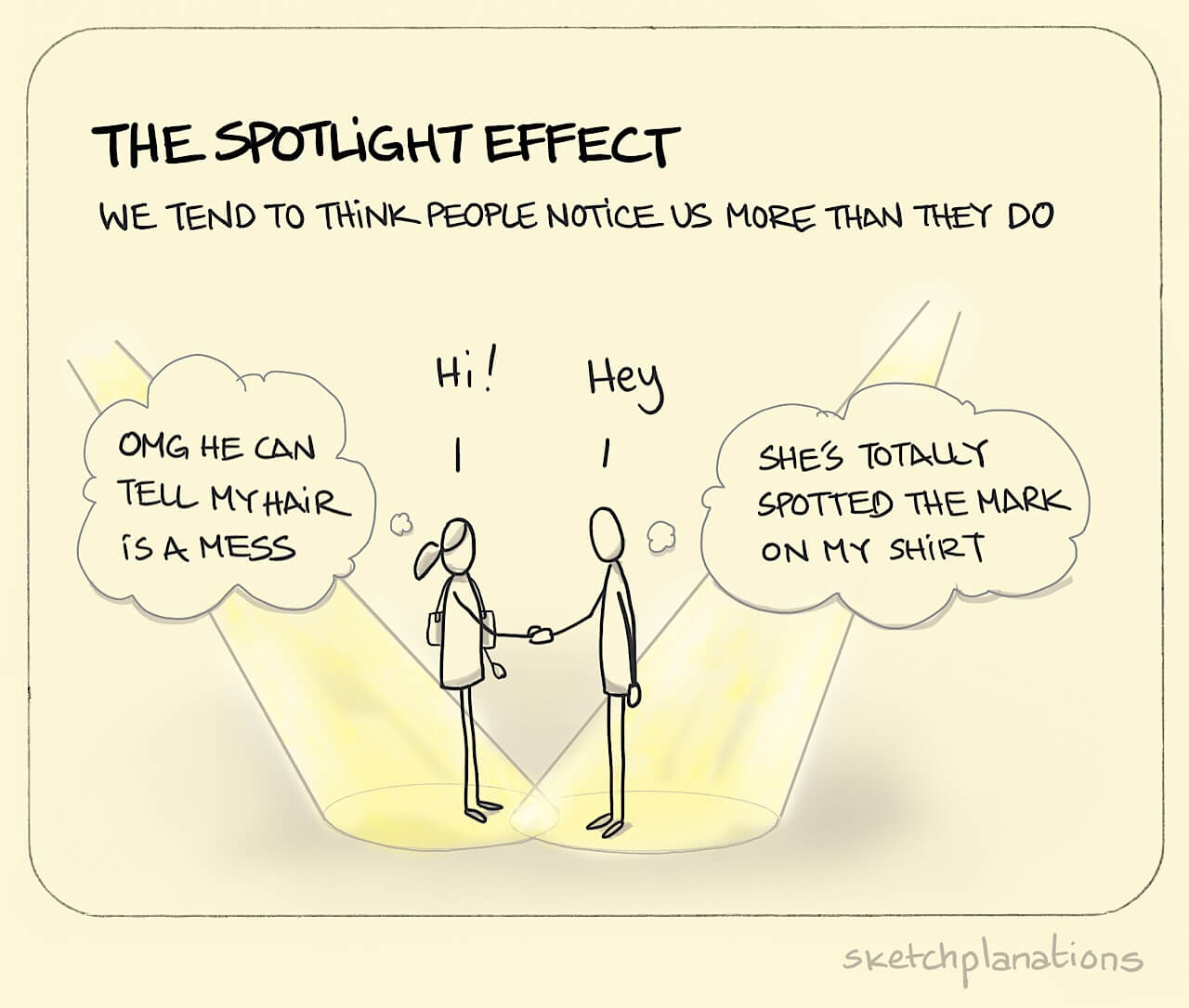
In your world, you are the protagonist. In their world, they are. You focus on gathering information revolving around your needs. Other people tend to view and collect information from the environment to benefit themselves. Chances are, your bad hair day was only visible to you. The person you met on the way might have been obsessing over their neighbour, who pointed out that their fly was open or just obsessing over their erstwhile open fly.
Combating Spotlight Effect
- Reverse the narrative: Observe others with kindness and empathy. You will naturally start feeling others are also observing you in a similar light.
- If you struggle with Spotlight effect and related social anxiety, consider cognitive behaviour therapy (CBT) for long-term solutions.
- Remember to move on if you make an error during the interview process. Inject the logic that this mistake is not as big as you might make it out to be.
I hope this has been helpful. Would love to read about your interview experiences and other cognitive effects that come into play when you are an interview candidate. All the best!
 Analogikal
Leave a comment